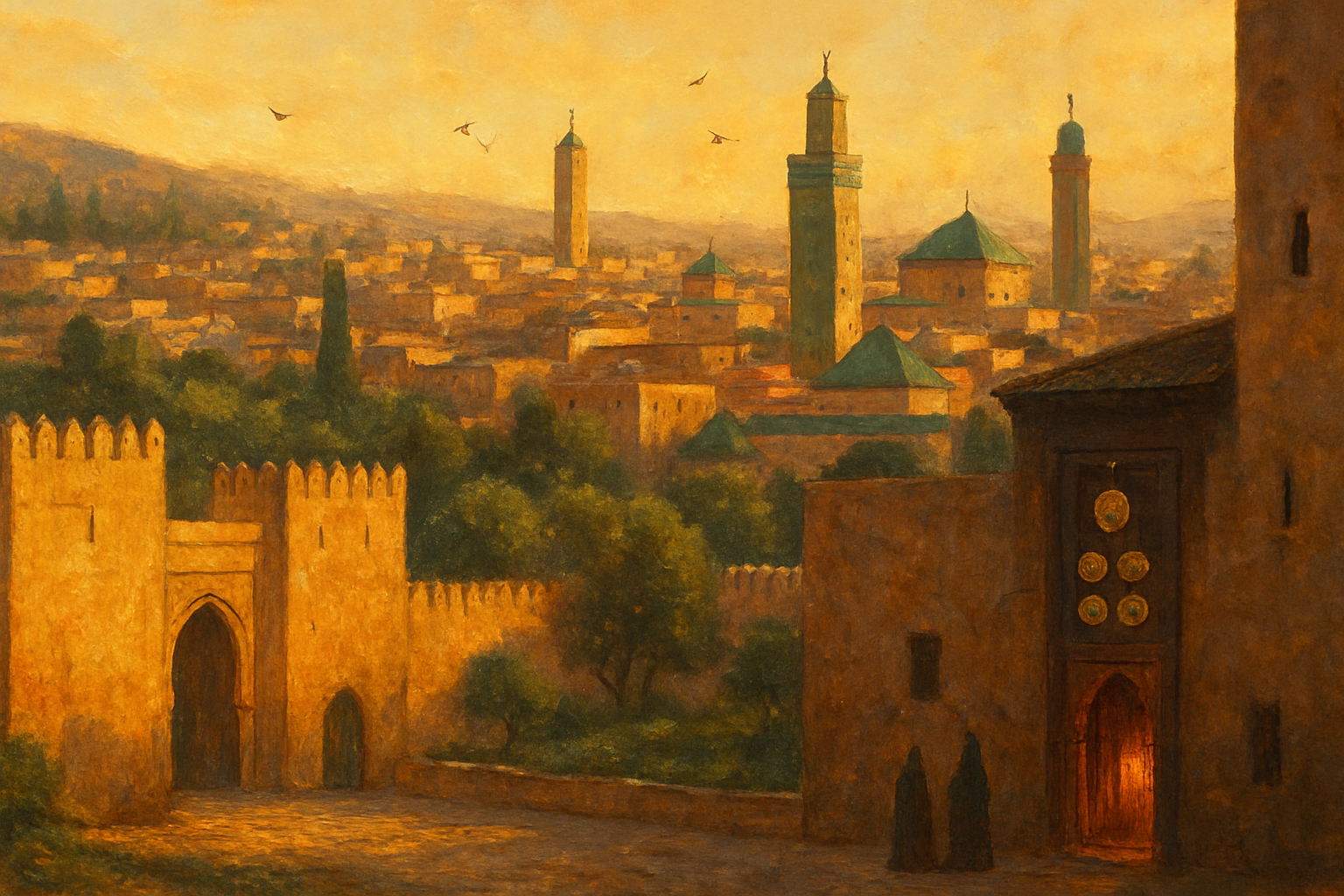
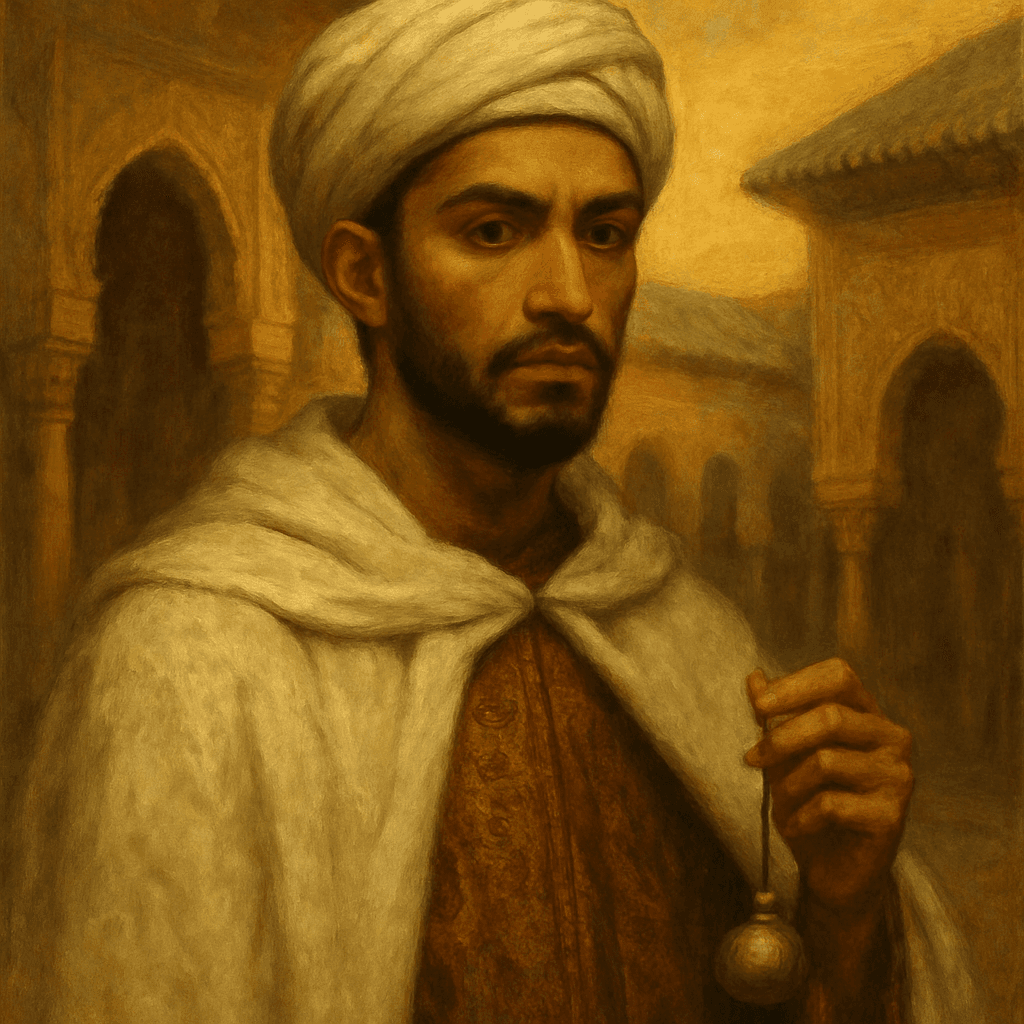
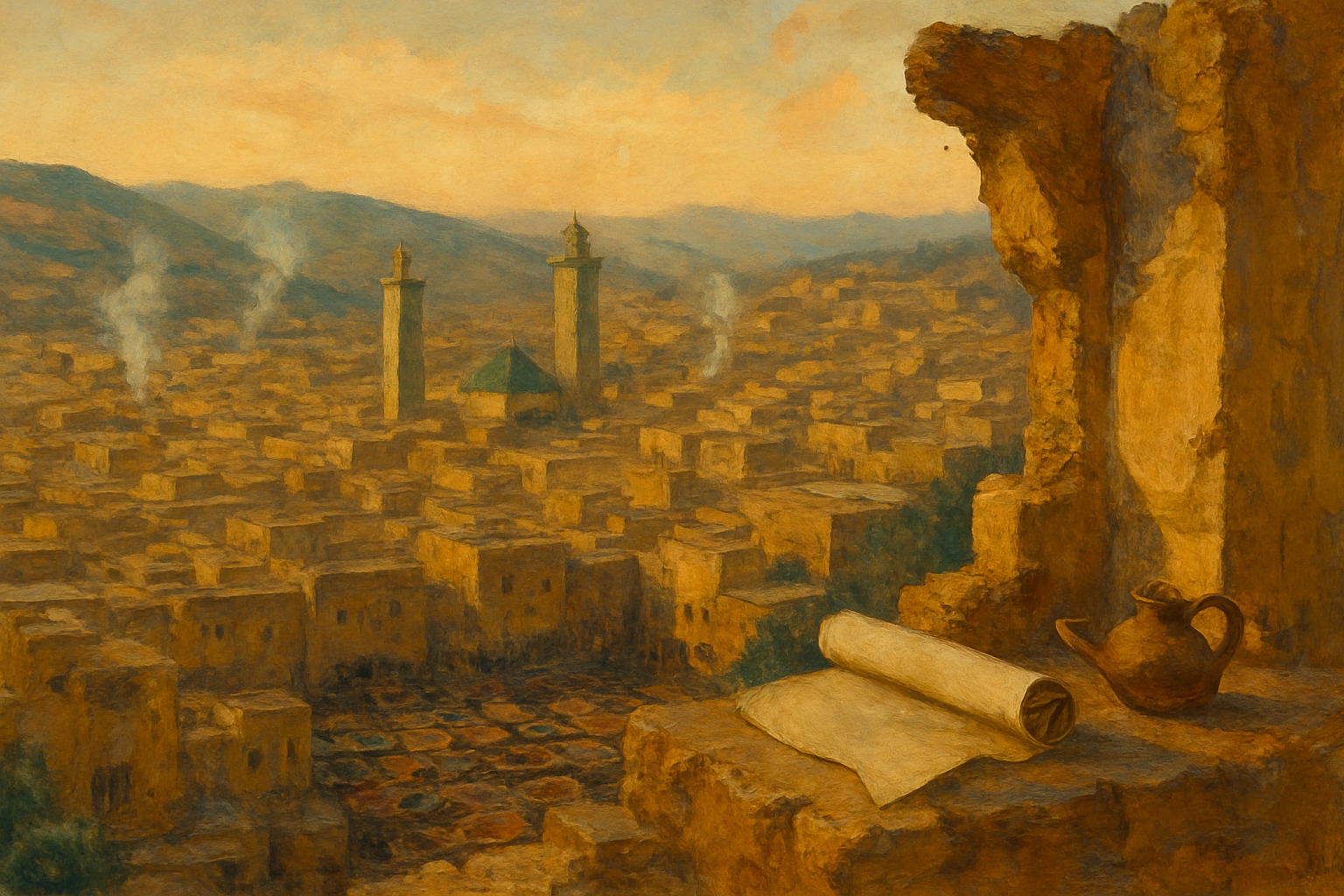
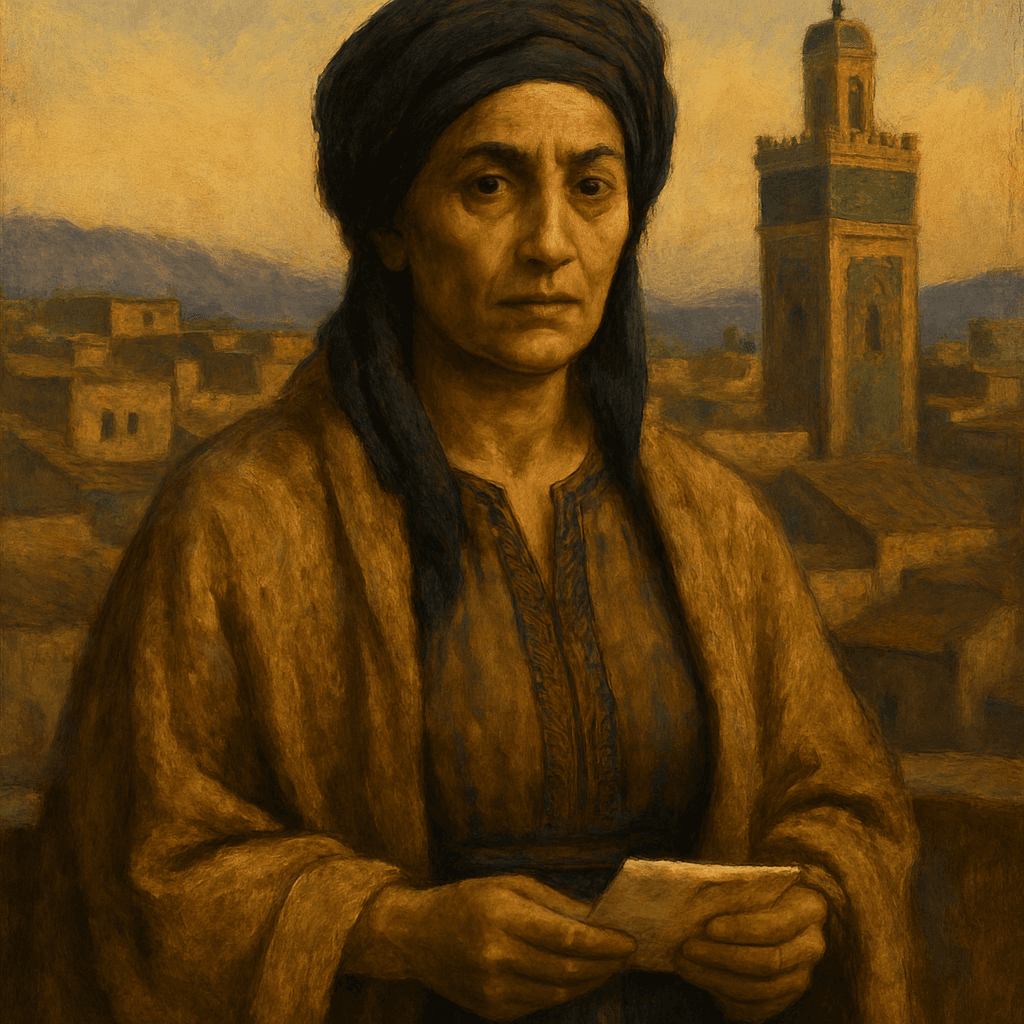
A Marinid sultan walks you from his palace gate to the world's oldest university.
Royal Palace of Fez
Bou Inania Madrasa
University of al-Qarawiyyin
Bab Dekkakin
Jnan Sbil Gardens
Dar Batha
“I am Abu Inan Faris, and everything you are about to walk through, I either built, paid for, or lost. They say I spent too much on a school. They say I took a throne that was my father's. Both are true, and I would do both again — but I need someone to walk…”
Royal Palace of FezBab Bou JeloudUniversity of al-Qarawiyyin
This month: The light turns amber over Dar Batha's tiled roofs, and the gardens smell faintly of ripening quince. Autumn suited my temperament — I only wish I had known that then.
1Royal Palace of Fez — The vast royal palace of Fez, whose brass and zellij gates at Place des Alaouites are its most public face.
2Bab Dekkakin — A fortified ceremonial gate standing between the Old and New Mechouars on the northern edge of Fes el-Jdid.
3Jnan Sbil Gardens — A public garden laid between Fes el-Jdid and Fes el-Bali, watered by the river that made both cities possible.
4Dar Batha — A 19th-century royal palace begun by Sultan Hassan I, now a museum of Moroccan arts with over 6,500 objects.
5Bab Bou Jeloud — The ornate main gate into Fes el-Bali, built by the French administration in 1913 as a grand entrance to the old city.
6Dar al-Magana — The 14th-century house whose street façade carries an elaborate weight-driven water clock, built to keep the madrasa's hours.
7Bou Inania Madrasa — Built 1350–55 by Sultan Abu Inan Faris, the only madrasa in Morocco that also served as a congregational mosque.
8Fondouk el-Nejjarine فندق النجارين — A restored caravanserai of the carpenters' quarter, now a museum of wooden arts and crafts.
9University of al-Qarawiyyin — Founded as a mosque by Fatima al-Fihri in 857–859, and cited as the oldest continually operating institution of higher learning in the world.
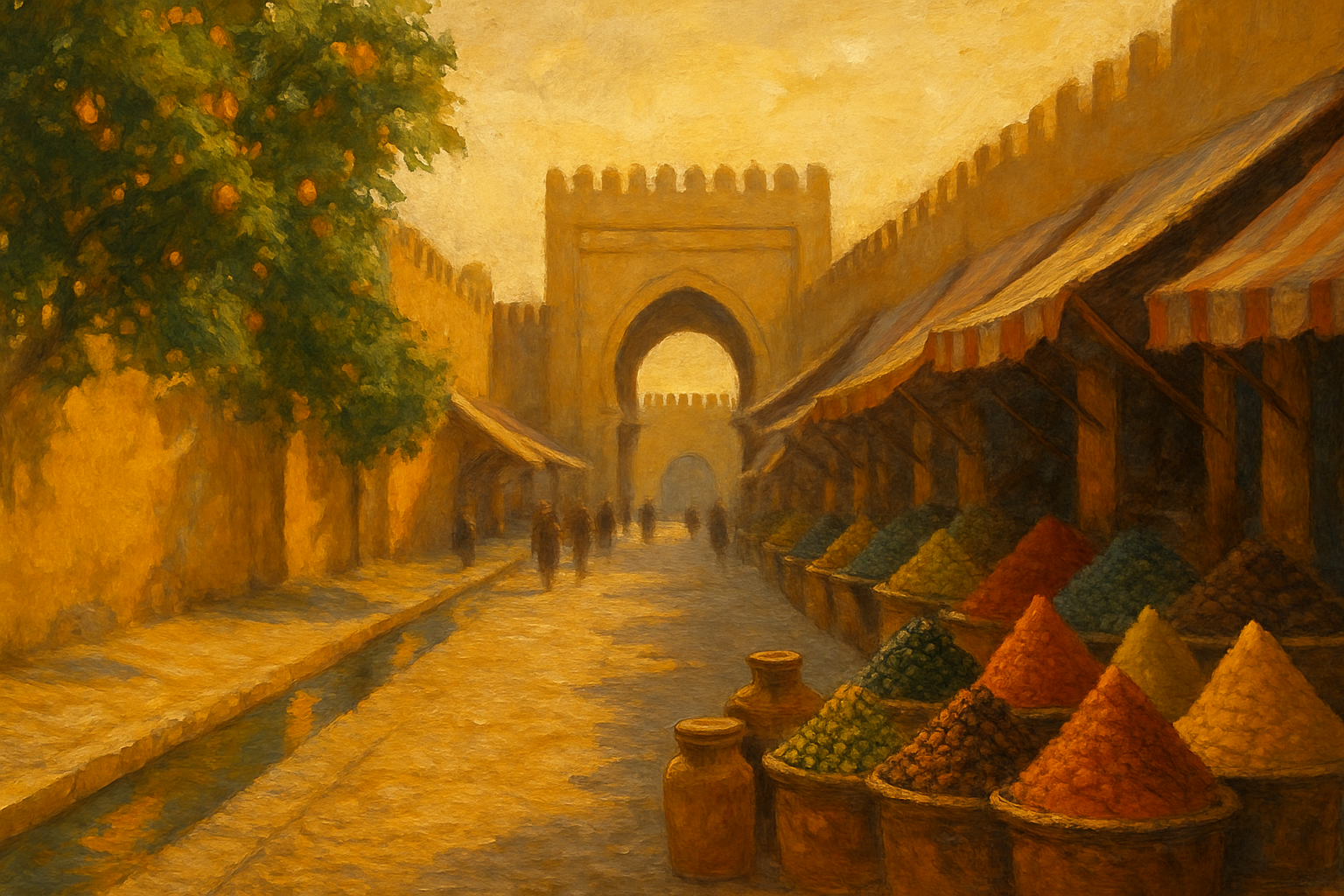
A homesick traveller walks New Fez by smell: bread, salt, smen and orange blossom.
Jnan Sbil Gardens
Royal Palace of Fez
Bab Chems
Grand Mosque of Fes el-Jdid
Bab Semmarine
Mellah of Fez
“They call me Leo in Rome, which is not my name. I am al-Hasan, raised in Fez, and in a cold room far from here I once filled a hundred pages with this city's ovens and mills and markets because it was the only way I could still smell it. But a list is not a…”
Jnan Sbil GardensRoyal Palace of FezMellah of Fez
This month: The gardens soften into autumn color, and the Oued Fes runs easier now that the summer's thirst has passed.
1Jnan Sbil Gardens — The old royal garden between the two Fezzes, watered by the Oued Fes that once drove the city's mills. Public garden, free; open daylight hours. Mint tea and juice are sold near the gates for around 10–15 MAD.
2Bab Chems — A city gate on the garden's edge where produce came in and out between old and new Fez. A street gate, always open and free; nothing sold at it — buy nothing here, save your dirhams for the market below.
3Grand Mosque of Fes el-Jdid — The congregational mosque of Fes el-Jdid, founded with the royal city itself, its quarter fed by communal ovens. Working mosque, closed to non-Muslims; seen from the street. A round loaf from any nearby ferran or bakery costs 1–2 MAD.
4Riad — The working market in the heart of Fes el-Jdid, still selling olives, oil, preserved butter and spice. A working street market, free to walk through. Buy a handful of olives or a paper cone of dates for a few dirhams (roughly 5–15 MAD); small coins are kinder than notes.
5Bab Semmarine — The monumental southern gate of Fes el-Jdid, its arch lined with dried-fruit and nougat sellers. A public gate, always open and free to walk through. The trays under and beside the arch usually hold dried figs, dates, raisins and nougat — a small bag is a few dirhams (around 10 MAD).
6Mellah of Fez — The historic Jewish quarter of Fez beside the palace, whose name is bound up with salt. A living quarter of streets and shops — walk it freely, quietly, and photograph people only with a word first. Preserved lemons and spices are sold along the main lane for a few dirhams; the Ibn Danan Synagogue nearby charges a small entry fee.
A day in Fez with the mountain lord who ruled it and lost it.
Ibn Danan Synagogue
Bou Inania Madrasa
Dar al-Magana
Dar Glaoui
Funduq al-Najjarin
Zawiya of Moulay Idris II
“They call me Grand Vizier, but in Fez I am still the man from the mountain who smells of horses. I have a palace here, servants here, and not one friend among the scholars of this city. I am old now and there is a thing I must say out loud before it is said…”
University of al-QarawiyyinBou Inania MadrasaMarinid Tombs
This month: Autumn light now, gentler on the tilework than summer's glare — you will see the madrasa's carving properly for the first time.
1Ibn Danan Synagogue — A 17th-century synagogue in the Jewish quarter of Fes el-Jdid, restored and reopened in 1999. The Ibn Danan Synagogue is open to visitors most days for a small entrance donation; the lane outside is public.
2Bou Inania Madrasa — The 14th-century Marinid madrasa on Tala'a Kebira, the only one in Morocco that also served as a congregational mosque. Open to visitors, 20 MAD; closed to non-Muslim visitors around Friday midday prayers.
3Dar al-Magana — The 14th-century water clock across the street from the madrasa, its brass bowls and beams still set into the façade. Seen from the street only — the façade is the monument. Stand across the lane and look up.
4Dar Glaoui — The late 19th- and early 20th-century palace of the Glaoui family in the southwestern district of Fes el-Bali. Usually open to visitors for a small fee (around 25 dirhams when last recorded); hours are informal — knock and see.
5Funduq al-Najjarin — A historic caravanserai on Nejjarine Square, with its attached public fountain, now a museum of wooden arts and crafts. The Nejjarine Museum of Wooden Arts & Crafts is inside, open daily 10:00–17:00, ticketed; the square, the doorway and the fountain are free at any hour.
6Zawiya of Moulay Idris II — The shrine of Idris II, founder and patron saint of Fez, at the centre of the medina beneath its pyramidal roof. A working shrine, one of Morocco's holiest; non-Muslims may not enter but the lanes, the horm beam and the doorways are open to all.
7Al-Attarine Madrasa — A small Marinid madrasa of 1323–25 beside the spice and perfume souk, famous for its dense, harmonious decoration.
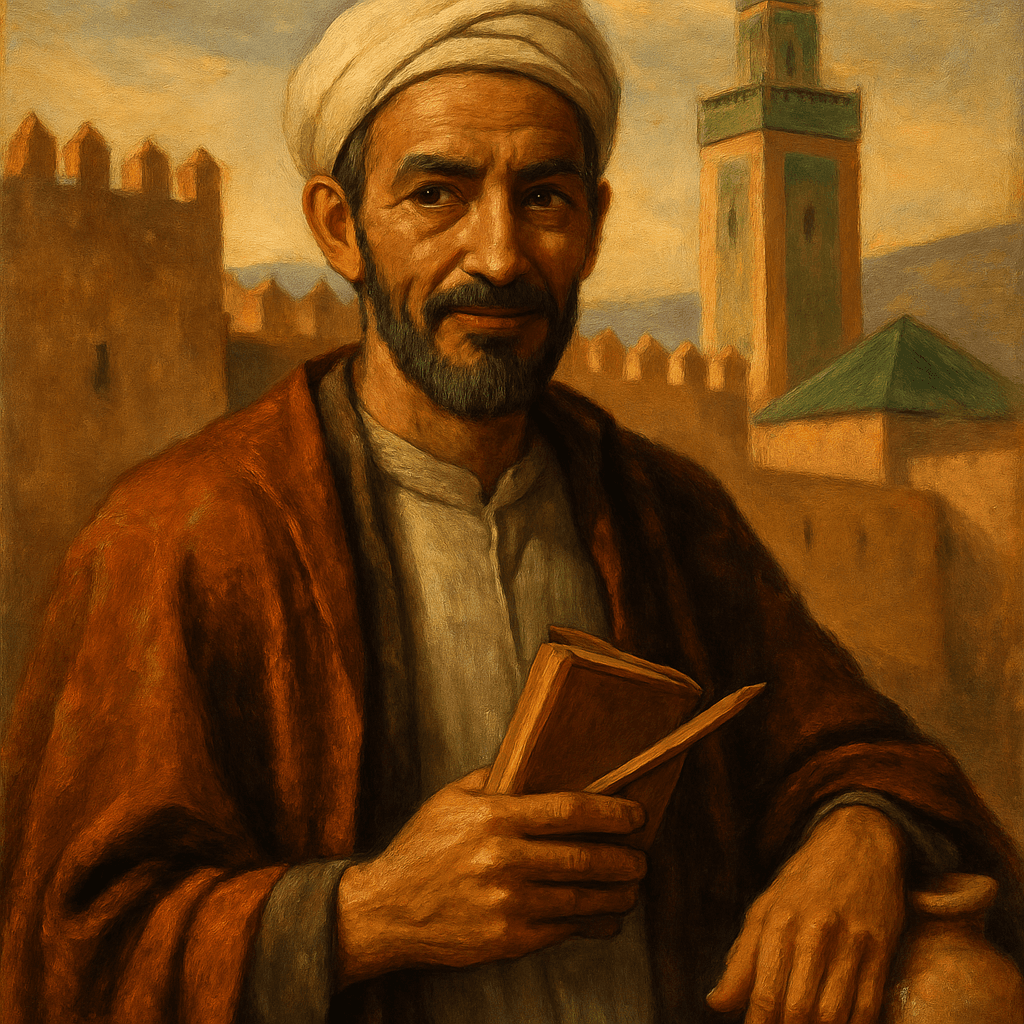
A Granadan poet, condemned in Fez, walks you through the city that kept him.
Royal Palace of Fez
Jnan Sbil Gardens
Dar Batha Museum of Islamic Arts
Ibn al-Khatib
Marinid Tombs
Al-Attarine Madrasa
“I am Lisan ad-Din Ibn al-Khatib, once the tongue of Granada, latterly a guest of Fez — a guest, let us say, who was not permitted to leave. I wrote the history of my own city, my own life inside it, which is the vanity of a man who suspected he would need a…”
Royal Palace of FezMarinid TombsAl-Qarawiyyin
This month: The gardens turn toward autumn now, the leaves of Jnan Sbil thinning, and the water runs cooler under a gentler sun.
1Royal Palace of Fez — The Dar al-Makhzen, royal citadel since 1276, with its ornate 20th-century bronze gates on Place des Alaouites. The palace is a working royal residence — no public entry. The gates on Place des Alaouites are seen from the plaza, free, any time.
2Quartier Mellah — The Mellah, the Jewish quarter formed beside the Marinid royal district, with its 17th-century synagogue built by Mimoun Ben Sidan. A living quarter — walk the lanes freely; the synagogue interiors here keep irregular hours and some ask a small donation.
3Jnan Sbil Gardens — A 7.5-hectare public garden between the two old cities, fed by the Oued Fes and planted with thousands of species. Public garden, free, open daylight hours — but closed on Mondays.
4Dar Batha Museum of Islamic Arts — A former palace, now the museum of Moroccan arts, holding pottery, woodwork and two Marinid tombstones. Museum, open 10:00–18:00, closed Tuesdays; the courtyard entrance is worth the stop even when shut.
5Bab Boujloud — The triple-arched ornamental gate into Fes el-Bali, blue outside, green inside, built in 1913. A public city gate — always open, free; busy with foot and mule traffic, stand clear of the central arch.
6Ibn al-Khatib — The site associated with Ibn al-Khatib, the Granadan poet, historian and vizier who died in Fez in 1374. An open medina lane, free and always busy; there is no monument or plaque here — the stop is the street itself.
7Marinid Tombs — Ruined 14th-century royal mausoleums on the hill north of the medina, and the city's best-known lookout.
A merchant's daughter walks her whole city, from the blue gate to the hill of tombs.
Jnan Sbil Gardens
Bou Inania Madrasa
Dar al-Magana
Funduq al-Najjariyyin
Al-Attarine Madrasa
University of al-Qarawiyyin
“I am Fatima, daughter of Mohammed al-Fihri, of Kairouan and then of this town. My father died rich and I did the only sensible thing with the money: I turned it into a room where people could learn. That was more than a thousand years ago, and the room is…”
Bab BoujloudBou Inania MadrasaChouara Tannery
This month: A gentler light now, good for reading the carved cedar without squinting. This is the month I would have chosen to study, if I had been the one enrolled.
1Bab Boujloud — The triple-arched gate that everyone treats as the front door of old Fez. A public city gate — always open, free; the square outside is the cheapest place in the medina to eat.
2Jnan Sbil Gardens — Nineteenth-century royal gardens between the two halves of the medina, opened to everyone in 1917. Public garden, free, open daylight hours — but normally closed on Mondays, so plan the day around it.
3Dar Batha Museum of Islamic Arts — A former palace, now the museum where Fez keeps its pottery, woodwork and salvaged fragments. Museum in a former palace; ticketed and modest. Open Monday and Wednesday–Sunday, 10:00–18:00 — closed Tuesdays.
4Bou Inania Madrasa — The 1350–55 Marinid madrasa, the only one in Morocco that also served as a congregational mosque. Open to visitors for a small fee, 20 MAD; the prayer hall itself is viewed from the courtyard.
5Dar al-Magana — Dar al-Magana, the 14th-century water-clock façade standing opposite the Bou Inania Madrasa on Tala'a Kebira. Seen from the street only; stand back against the opposite wall to get the whole façade in view.
6Funduq al-Najjariyyin — A 1711 caravanserai on the carpenters' square, now the museum of Moroccan woodwork, with its tiled public fountain alongside. Museum of wooden arts and crafts, 20 dirham, open roughly 10:00–17:00; the façade and fountain are free to see from the square.
7Moulay Idriss II shrine — The shrine of Moulay Idriss II, founder of Fez, at the heart of the medina's holiest quarter.
Walking Fez
Fez is a city best met on foot: a walled medina too narrow for cars, gates like Bab Boujloud and Bab Semmarine that mark old borders still felt today, madrasas hidden behind carved doors, and hills where ruined tombs look down over the rooftops. A bus can only show you the outline. Walking the lanes between Jnan Sbil Gardens, the Qarawiyyin, and the tanneries is the only way to actually feel how the old and new cities fit together, and how the smell of bread ovens gives way to leather and orange blossom around every corner.
Walk & Tell turns that walking into a self-guided audio walk narrated by people who actually lived it — a Marinid sultan, a homesick Renaissance traveller, a deposed vizier, an exiled poet, the woman said to have founded the world's oldest university. Each walk runs on GPS, so it plays as you go, needs no signal once downloaded, and takes an hour or so for most routes, longer for the full-day one. It's free to try, and works well whether you have a single spare afternoon, want a proper Fez in one day, or are walking solo or as a couple with nowhere else to be.
Things to see in Fez on foot
University of al-Qarawiyyin — Founded in 857–859 by Fatima al-Fihri, cited as the oldest continually operating institution of higher learning in the world.
Bab Bou Jeloud (Bab Boujloud) — The triple-arched, blue-and-green gate built by the French in 1913, treated as the front door of old Fez.
Royal Palace of Fez (Dar al-Makhzen) — The brass and zellij gates on Place des Alaouites, seen from the square since the palace itself stays closed to visitors.
Bou Inania Madrasa — Built 1350–55, the only madrasa in Morocco that also served as a congregational mosque, open for a small fee.
Jnan Sbil Gardens — A free public garden between the two old cities, watered by the Oued Fes, closed on Mondays.
Mellah of Fez — The historic Jewish quarter beside the palace, home to preserved lemons, spice stalls, and the Ibn Danan Synagogue.
Dar al-Magana — A 14th-century weight-driven water clock set into a street façade, viewed from across the lane.
Al-Attarine Madrasa — A jewel-box 1323–25 madrasa by the spice market, ticketed, famous for its dense carved decoration.
Fondouk el-Nejjarine — A restored 1711 caravanserai on Nejjarine Square, now a museum of wooden arts with a tiled public fountain outside.
Marinid Tombs — Ruined royal mausoleums on a hilltop north of the medina, the tombs themselves closed but the lookout free, best near sunset.
Zawiya of Moulay Idris II — The shrine of the city's founder at the medina's holiest centre, closed to non-Muslims but its doorways open to all.
Tanneries view — A terrace overlooking round stone dye vats still worked daily, seen free from surrounding leather shops, strongest smell in the afternoon.
Questions people ask about Fez
What can I do in Fez in a few hours on foot?
You can walk from the Royal Palace gates through Bab Bou Jeloud to the Bou Inania Madrasa and the University of al-Qarawiyyin in about ninety minutes on the shortest Walk & Tell route. Longer routes stretch that same ground into a full Fez in one day, adding the Mellah, Jnan Sbil Gardens, and the hilltop Marinid Tombs.
Is Fez walkable?
Yes — the medina of Fes el-Bali is largely car-free by necessity, since its lanes are too narrow, so walking is really the only way to see it properly. The longer routes run up to 7 km across a full day, so comfortable shoes and an early start matter more than distance.
What are the free things to do in Fez?
Jnan Sbil Gardens is a free public garden (though closed Mondays), the gates of Bab Bou Jeloud and Bab Semmarine cost nothing to walk through, and the Royal Palace gates on Place des Alaouites can be seen from the square without charge. The Marinid Tombs hilltop and the doorways of the Qarawiyyin and Moulay Idris II shrine are also free, seen from outside.
Do I need a guide in Fez?
You don't need a human guide to get the history right — Walk & Tell's audio walks are narrated by figures like Sultan Abu Inan Faris or the exiled poet Ibn al-Khatib and run on GPS, so the story plays as you reach each stop. It's free to try, so you can test a walk before committing to a full route.
How long does it take to walk the medina?
The shorter themed walks run 62 to 86 minutes over 1.7 to 6.4 km, while the full vizier's-day route takes about 126 minutes across 5.2 km, and the exile's route runs 120 minutes over 7 km. Either can be spread across a longer morning if you linger at madrasas and gates along the way.
Does it work without data?
Yes — download the walk before you set out and it runs on GPS with no signal needed, which suits the medina's patchy connectivity well.
What is the best time of day to walk in Fez?
Early morning suits bread ovens and market stalls and keeps the medina lanes cool, while late afternoon is best for the Marinid Tombs and Borj Nord hill, which are bare and harsh at 2pm. Avoid 1–3pm at Place des Alaouites and the Mechouar, where there's no shade at all.
What is closed at the moment?
The Marinid Tombs themselves are temporarily closed to entry, though the hilltop and its panoramic view remain open and free. The Royal Palace, the Qarawiyyin prayer hall, and the Moulay Idris II shrine are all closed to non-Muslim visitors or the general public, and are seen from outside instead.
Walk & Tell is a self-guided audio walking-tour app. Walks are free to try; download one for offline before you set out. All cities
7Royal Palace of Fez — The great gilded gates of Dar al-Makhzen on Place des Alaouites — the public face of a palace whose kitchens fed a court. The palace itself is closed to visitors; the gates on Place des Alaouites are seen from the square, free. Cafés around the square do mint tea and a pastry for roughly 10–20 MAD.
When to go: Early morning while the bread ovens and the Grande Rue stalls are working, or after 5pm when the gardens cool; avoid 1–3pm, when Place des Alaouites and the Mechouar have no shade.
Open as a historic site to visitors; small entry fee. The courtyard and upstairs student rooms are the reason to go in.
8University of al-Qarawiyyin — The mosque founded in 857–859 that became the oldest continuously operating institution of higher learning in the world. A working mosque and university; non-Muslims cannot enter. Seen from the doorways and the lanes around it — free, always there.
9Marinid Tombs — Ruined royal tombs of the Marinid dynasty on the hill north of the medina, now the city's great lookout. The tombs themselves are temporarily closed — no entry. The hilltop around them is open ground, free, and is the city's great lookout; best in late afternoon.
10Borj Nord — A Saadian fort of 1582 on the northern hill, built on Portuguese models and now the Museum of Arms. The fort houses the Museum of Arms; ticketed, and the stop itself is told from the public edge of the grounds. The hill is bare — bring water and come in late light.
When to go: Give it a whole day and start by 9am. The Nejjarine museum opens 10:00–17:00, Bou Inania charges 20 MAD and closes to visitors around Friday midday prayers, and the hill stops — the Marinid Tombs and Borj Nord — are bare and brutal at 2pm but glorious in late afternoon light.
The ruins are fenced and temporarily closed; the hilltop and its panorama are open, free, and best near sunset. No shade — carry water.
8Tanneries view — The terrace view over Fez's oldest working tannery, its round stone vats of dye and lime still in daily use. The view is from the terraces of surrounding leather shops — entry is free but a tip is expected and you will be shown hides; strongest smell in afternoon heat.
9Al-Attarine Madrasa — A jewel-box Marinid madrasa of 1323–25, named for the spice and perfume market at its door. Open as a historic site, small ticket; the vestibule and the view through the screened archway can be had from the doorway if you don't go in.
10Mosque and University of al-Qarawiyyin — Founded in 857–859, the mosque and university of al-Qarawiyyin, teaching without interruption ever since. Non-Muslims cannot enter; the courtyard is glimpsed from the open doorways. Free to look from the lane.
When to go: Start by 9am: medina lanes are cool and shaded early, the Marinid hill has no shade at midday, and the tanneries smell strongest in the afternoon heat. Jnan Sbil closes on Mondays; Dar Batha closes on Tuesdays.
Entry is for Muslims only; the doorways and the brass-studded threshold are freely seen from the lane.
8Al-Attarine Madrasa — A jewel-box Marinid madrasa of 1323–25 beside the spice market, built to house students of al-Qarawiyyin. Open as a historic site, small ticket; the carved doorway is free to see from the lane.
9University of al-Qarawiyyin — The mosque founded in 857–859 that grew into the world's oldest continually operating place of higher learning. Non-Muslims cannot enter the prayer hall; the doorways along the surrounding lanes give the view. The historic library nearby has separate, limited access.
10Saffarin Madrasa — The coppersmiths' square and the Saffarin Madrasa of 1271, the first madrasa the Marinids ever built. The square is public and always open; the madrasa doorway is best seen from outside — opening is irregular.
When to go: Start by 9am: the tanneries are best before the sun heats them, Jnan Sbil is closed on Mondays and Dar Batha shuts Tuesdays, and the Marinid Tombs are made for the late-afternoon call to prayer.