
City walk · Seoul · South Korea
Joon Lee
27-year-old Korean songwriter, warm and grounded, short sentences, reacts before he explains — “ah”, “mm”, “야” — a slight smile in the voice, never a tour guide
Read what Joon Lee says
Ah — you came. Okay. I’m Joon. I write songs in Yeonnam-dong, near Hongdae, in a room where my cat sits on the desk and ruins takes. When a song won’t finish I come downtown and walk this exact line, always the same order, always at night. Tonight I’m walking it for a reason I’ll tell you later — mm, not yet. Just walk with me and look where I look.
7 stops · 1.8 km
about 31 min walking, 28 min listening at the stops — going inside is extra · Tap a stop on the map for a preview.
Where it takes you
1 / 6


Best time to walk: Best after 5pm or early morning — Sejong-daero and Seoul Plaza have no shade at 2pm. Deoksugung charges admission and closes Mondays, so check the gate before you count on going in; the walk works from outside either way.
59 min · 1.8 km · 7 stops · easy
You’re walking this one before anyone at Walk & Tell has. If something looks wrong, tap Report at any stop — we’ll fix it for everyone after you.
Partly shadedBest time to walk: Best after 5pm or early morning — Sejong-daero and Seoul Plaza have no shade at 2pm. Deoksugung charges admission and closes Mondays, so check the gate before you count on going in; the walk works from outside either way.
The walk
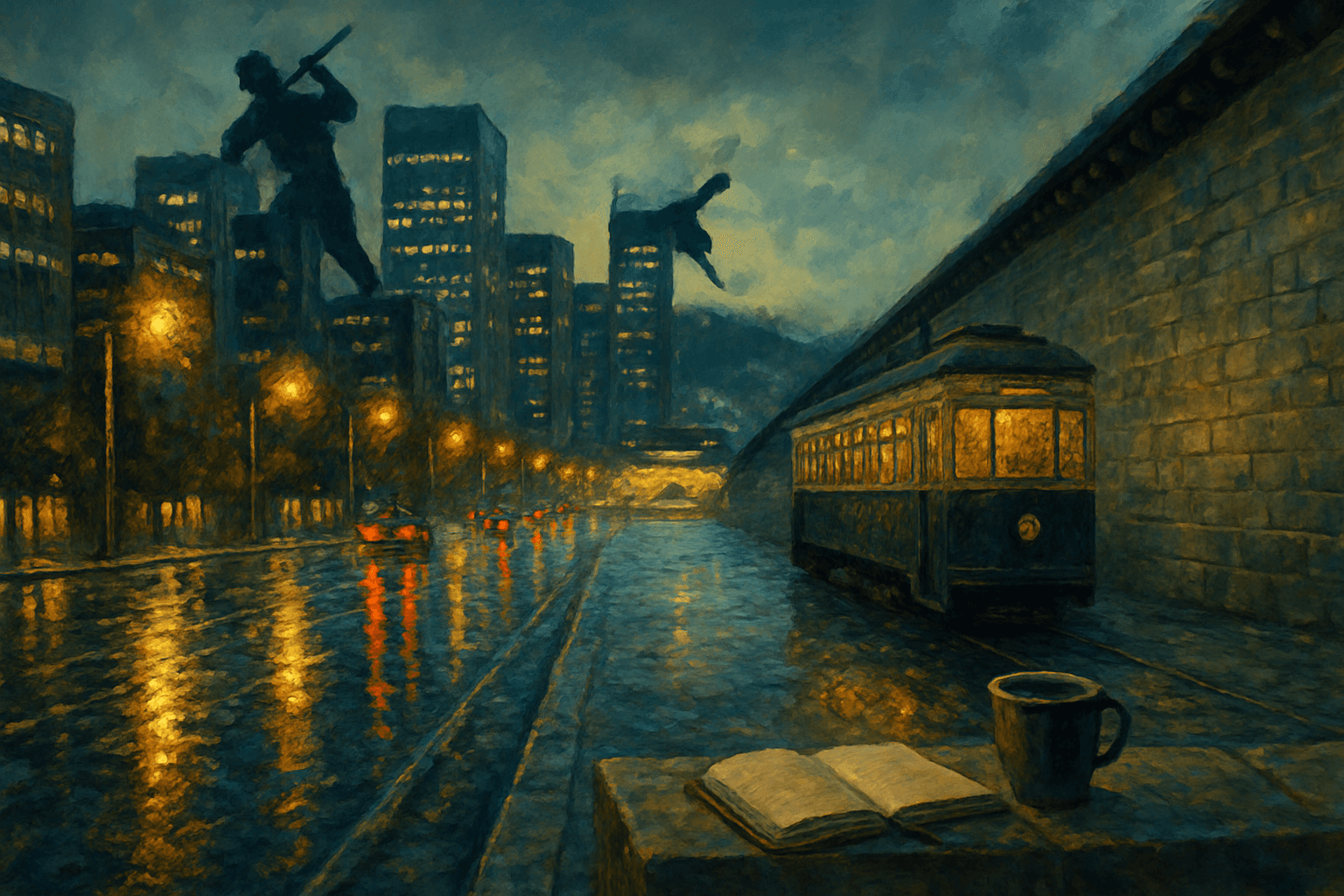
Joon Lee writes songs in a small room near Hongdae, and when he can’t finish one he takes the subway downtown and walks this line: the gate that isn’t there, the big black hammering man, an old streetcar, a palace wall, and a lawn to sit on. No puzzles — just him talking, the way a friend talks at night. Along the way the real history of Jung-gu keeps interrupting him: 1396, 1902, 1910, 1933. It’s a short walk, mostly flat, and it ends somewhere you can sit down.
Start here
새문안로, 사직동
Stand at the Donuimun (West Big Gate) site marker on Saemunan-ro, at the top of the hill west of Gwanghwamun — the spot where the old West Gate stood. Face east, downhill.
Directions