
City walk · Sultanahmet, Istanbul · Turkey
1611–1682 · a real person
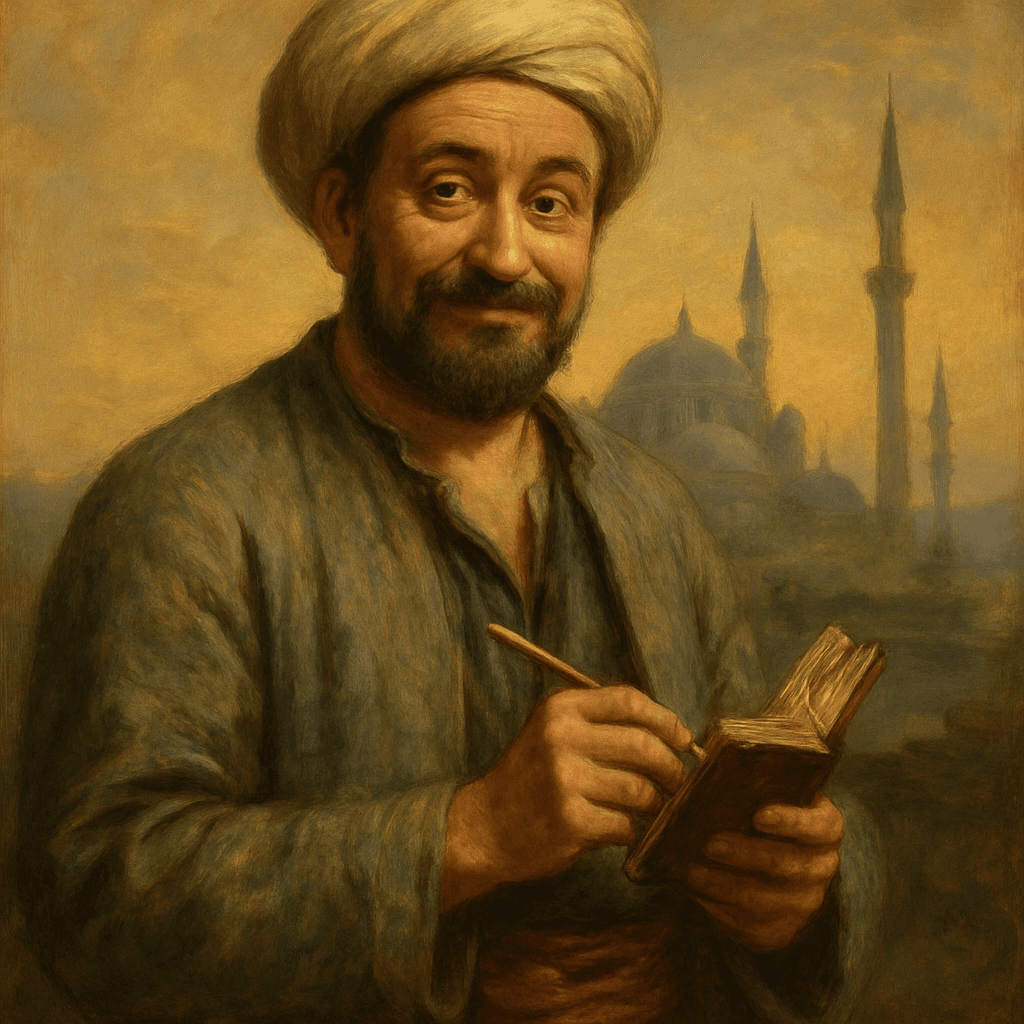
A garrulous, warm, boastful 17th-century traveller: exact about numbers, fond of a tall tale, homesick beneath the jokes.
Peace be upon you. I am Evliya, son of the sultan’s goldsmith, born within a bowshot of where your feet are now. Everything I own fits in a saddlebag, and everything I know is in ten volumes nobody has finished reading — but there is one thing I never wrote plainly, and it began with a single word said wrong in a dream. Walk with me down this hill, from the mosque of Sultan Ahmed to the spice quays, and I will tell it in nine pieces. Keep your eyes open: this city only shows itself to people who are moving.
You’re walking this one before anyone at Walk & Tell has. If something looks wrong, tap Report at any stop — we’ll fix it for everyone after you.
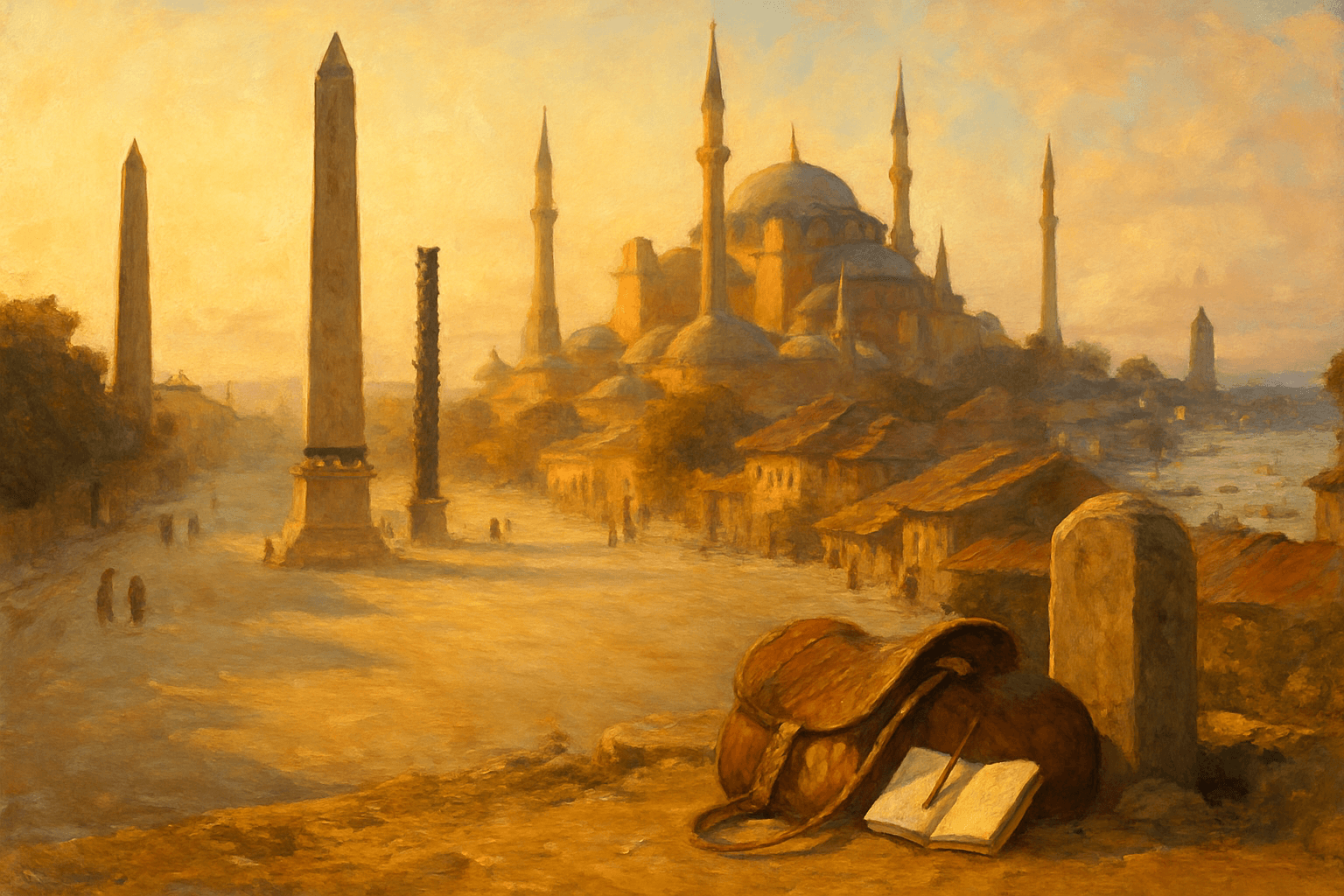
Nine places along the first hill of old Constantinople — the Sultan Ahmed Mosque, the Egyptian obelisk on the old racetrack, a vizier’s palace, the sunken cistern, Hagia Sophia, the gate of Topkapı and the spice market by the water — told as one continuous story by the city’s most famous traveller. No puzzles: just a voice in your ear and things to notice with your own eyes. The route is a single line downhill from Sultanahmet to Eminönü, so you never walk the same stone twice. It is the densest kilometre of history in Istanbul, and it was this man’s childhood neighbourhood.
Sultanahmet · 8 stops · 1.7 km
about 32 min walking, 33 min listening at the stops — going inside is extra · Tap a stop on the map for a preview.
1 / 6
Best time to walk: Early morning or after 5pm — the Hippodrome square has no shade at midday. Avoid prayer times at the Blue Mosque and Hagia Sophia; Topkapı is closed on Tuesdays and the Spice Bazaar shuts by 19:00.
Start here
7 Atmeydanı Caddesi, Sultan Ahmet Mahallesi
Stand in the outer courtyard of the Blue Mosque (Sultan Ahmed Mosque), on the side facing the open square, where you can see the minarets against the sky.
DirectionsBest from stop 1 — the story is told in order. Tap Start here on any stop to begin there instead; the guide will catch you up.
Blue Mosque, Istanbul
“The Mosque of Sultan Ahmed”
The imperial mosque built between 1609 and 1617 for Ahmed I, famous for its six minarets and its blue Iznik tiles.
Obelisk of Theodosius
“The Stone That Outlived Everyone”
An Egyptian obelisk of Pharaoh Thutmose III, carved around 1450 BC and re-erected here by Theodosius I in 390.
Turkish and Islamic Arts Museum
“The Vizier’s House on the Racetrack”
The 1524 palace of Pargalı İbrahim Pasha, grand vizier to Suleiman the Magnificent, now the Turkish and Islamic Arts Museum.
German Fountain
“The Kaiser's Fountain”
A neo-Byzantine domed fountain built in Germany, shipped in pieces and assembled at the top of the old Hippodrome in 1900 to mark Kaiser Wilhelm II's visit.
Basilica Cistern
“The Sunken Palace”
Justinian’s 6th-century underground reservoir, 336 marble columns holding up a roof of brick, reached by 52 steps.
Hagia Sophia
“Holy Wisdom”
Completed in 537 as the world’s largest interior, cathedral for nearly a thousand years, mosque since 1453.
Topkapı Palace
“The Gate of the New Palace”
The palace Mehmed the Conqueror began in 1459, home and administrative centre of the sultans for four centuries.
Procession Kiosk
“The Kiosk Above the Parade”
The small pavilion on the outer palace wall from which sultans watched processions pass along the road below.
The walk passes these without stopping. Add one and the route bends to take it in — the guide has nothing to say about them, so you are on your own there.
Born in Istanbul and raised beside these very walls, he recited in Hagia Sophia, served as a page inside Topkapı, and wrote the most famous description of this city’s markets, monuments and processions in his ten-volume Seyahatnâme.

1611–1682
Evliya Çelebi (born 1611 in Istanbul) was an Ottoman traveller and writer, son of a court goldsmith. He was taken into palace service under Sultan Murad IV and later spent some forty years travelling the Ottoman world and beyond, recording what he saw in the ten-volume Seyahatnâme (Book of Travels). His account of Istanbul’s guilds, markets and monuments — including the Grand Bazaar, of which he left the most important historical description, counting its shops, gates and fountains — remains a primary source for the 17th-century city. He famously wrote that his wandering life began with a dream in which he asked for travel when he meant to ask for intercession. He is thought to have died around 1682–1684, most likely in Cairo, far from the city he described best.
4.0 from 1 player
Isabella
Sep 21, 2026
Hard to find a stop
9- The Egyptian Market is practically another district, with so many other things to see around it. Since the walk from 7 to 9 is long, and you'd also have to walk back, I believe 9 is in the wrong group.